
A Bridge Across the Aisle for Families
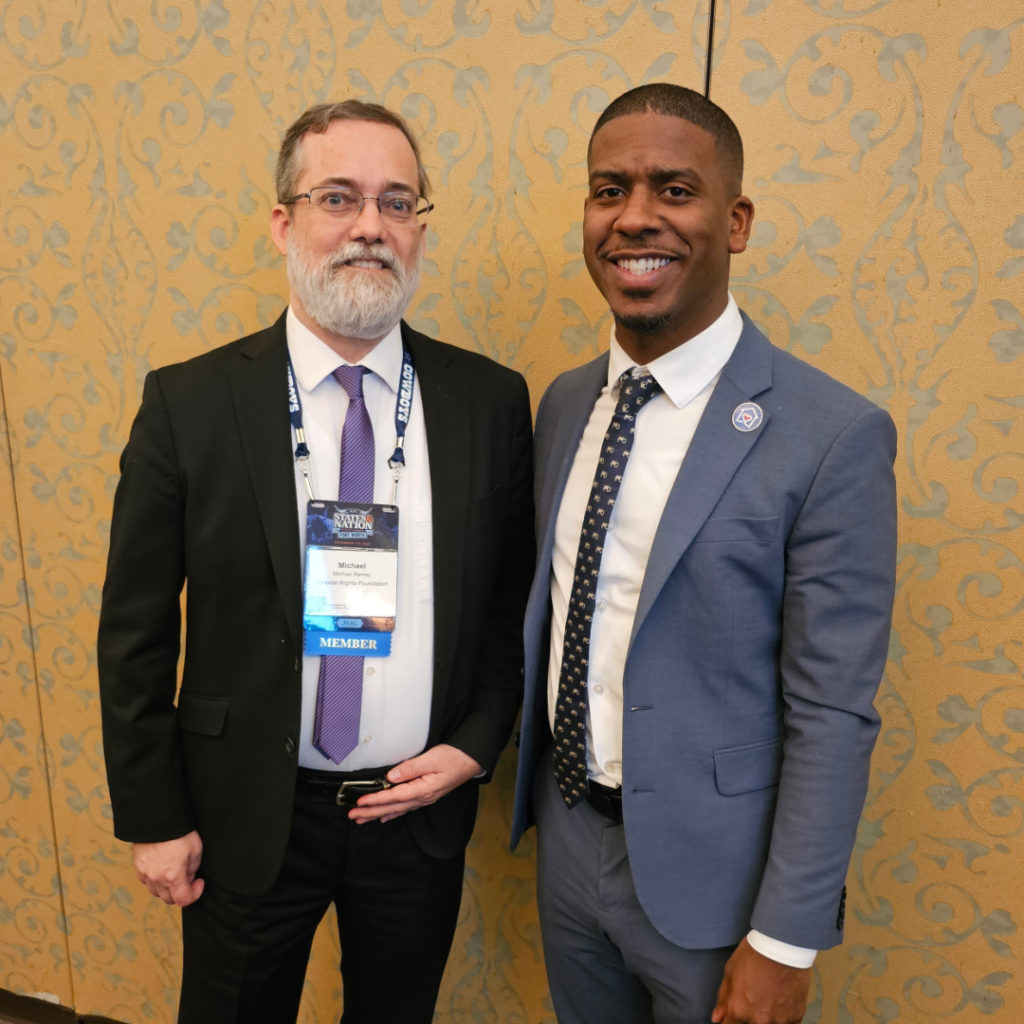
PRF President Michael Ramey with Think of Us CEO Sixto Cancel in Ft. Worth, Texas, on Dec. 3, 2025.
Last week, I attended the American Legislative Exchange Council’s (ALEC) annual States and Nation Conference in Fort Worth, Texas, to present a model policy on Family Separations.
ALEC is a cooperative of conservative state lawmakers and private entities like the Parental Rights Foundation, who meet to discuss and shape model policies for state legislation. Based on its conservative focus, it is unashamedly Republican.
Our model policy on Family Separations, on the other hand, was drafted by a bipartisan coalition, including members from the American Civil Liberties Union (ACLU) and the American Bar Association (ABA), working closely with members from PRF and the Texas Public Policy Foundation (TPPF).
The aim and strength of this Coalition to End Hidden Foster Care is to remove partisan barriers and put forth policies both sides can agree on. And my trip to ALEC proves that we are reaching that goal.
As I said, several left-leaning lawyers were an integral part of drafting this model bill. There are lawyers whose organizations would never be allowed to join ALEC—and who would never want to. In terms of partisan politics, ALEC would be their enemy.
But on the issue of parental rights and family defense, we are all on the same page.
As a member of both the Coalition to End Hidden Foster Care and ALEC, and as someone welcome on the political right, I had the privilege of serving as the “bridge across the aisle,” taking our model from one group to the other.
In practical terms, that looked like talking to lawmakers about our model last week, then presenting it before a “task force” (committee) on Health & Human Services, where it was put to a vote.
I didn’t hide the fact that the proposal was bipartisan. In fact, I find that one of the highlights of our model: it has already been vetted by both sides, with all the potential “red flags” taken out.
At the end of the day, our model received unanimous support, both from the public sector (elected legislators from various states) and the private sector (other nonprofits and for-profit corporations who are also members of ALEC). It is still listed on ALEC’s website as a “draft” model, but that will change in the next week or so as their IT team makes the updates from the conference.
So, what does our model say?
Our model covers instances where the state’s (or local) child welfare agency is involved with a family and suggests a Voluntary Placement Agreement. Such agreements are increasingly popular since the passage of the Family First Prevention Services Act in 2018 as a means to prevent foster care. But in many states, they are ripe for coercion and abuse since they do not involve any kind of court oversight or data tracking (leading to the unofficial title, “Hidden Foster Care”).
This kind of prevention certainly has its benefits: Instead of being removed to foster care with strangers, the children are moved to the home of a relative or close friend chosen by the parents. This means less trauma and disruption for the child. And the parents don’t have to go to court to defend themselves, either.
But, again, there is the potential for problems, such as pitting parents against the very kin they chose to provide the childcare, and the fact that there is no judge involved to make sure things are done properly.
That’s where our model comes in. It includes a section to make sure the parent’s rights are being protected—rights to have the details in writing, to know the aims and time limits of the separation, to rescind their agreement to the arrangement at any time, to have a lawyer advise them, and so on. This section makes sure the arrangement is truly voluntary, not coerced, and that it is designed to serve the family’s needs rather than the agency’s convenience.
It also includes a section to protect the rights of the affected children, such as a right to know what’s happening, to have a say (depending on their age) in the details, and to keep disruptions of their life to a minimum. (This means a family member in their same school district or close to their same church community would be a better choice than a family member two counties away.)
And there’s even a section to protect the rights of the caregivers, including the right to say “no” in the immediate timeframe, but to still be considered as a potential placement later on if the circumstances change.
Texas passed a similar law in 2023; the lawmakers who passed it and are members of ALEC were notably supportive of our model. They understand from their own experience the need for these reforms to protect families at their most vulnerable time.
I am proud to present this model for the coming legislative session and will work with lawmakers in any state who want to bring it to the floor. And I am especially proud to be the bridge across the aisle to make sure this important work gets done.
Thank you for standing with us and empowering us to build bridges to protect families by securing parental rights!